
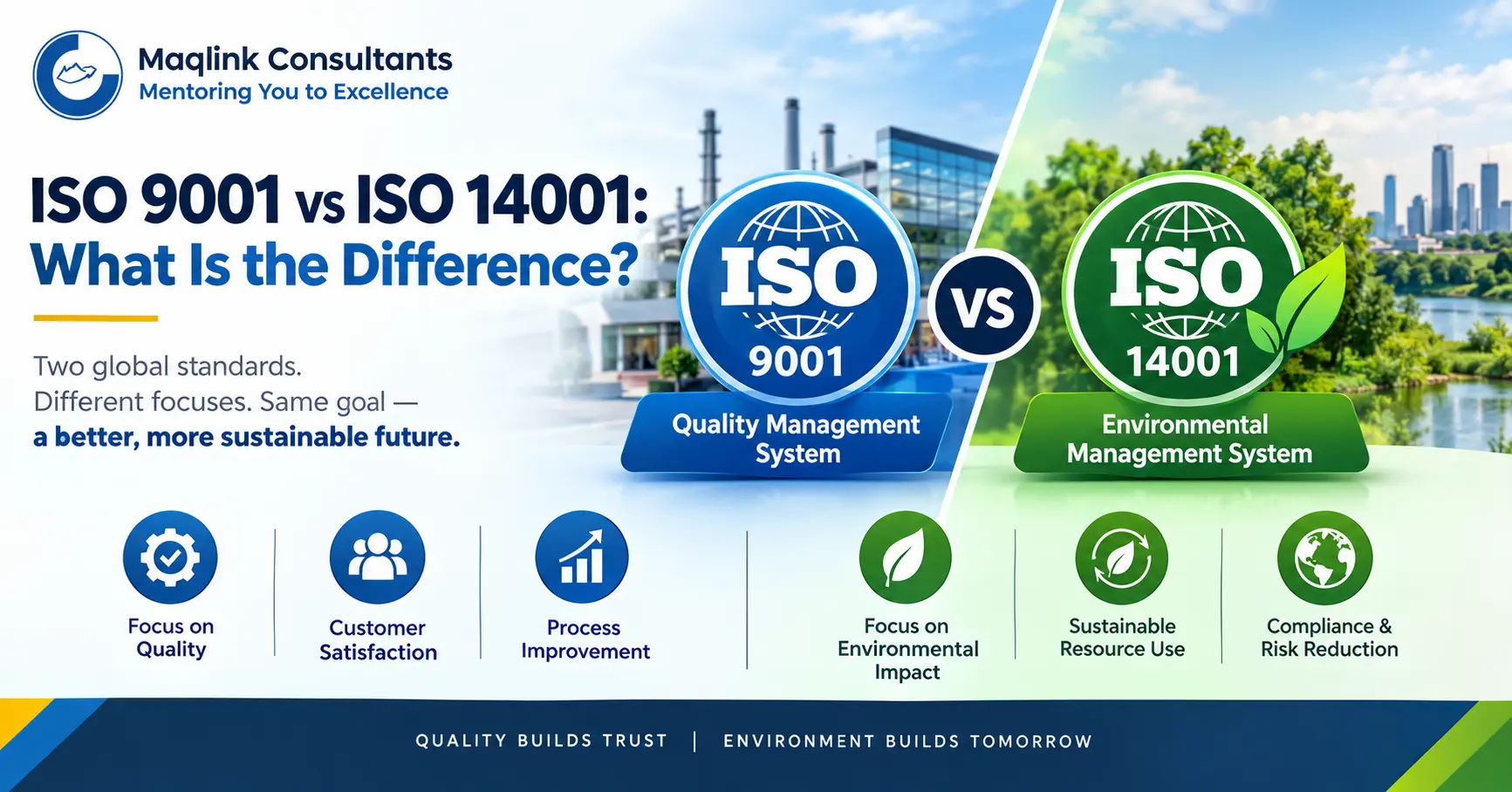
Business owners in Kuwait often hear these two standards mentioned in the same breath and assume they cover the same ground. They do not. Both belong to the ISO management system family, both follow a similar structure, and one certification body can audit them together. Still, they answer two separate questions. ISO 9001 asks whether you consistently deliver what your customers expect. ISO 14001 asks whether you control the effect your operations have on the environment. Knowing which one fits your business, or whether you need both, saves time and audit fees.
What ISO 9001 covers
ISO 9001 is the international standard for quality management systems. Its centre of attention is the customer. An organisation has to understand what customers need, build clear processes to meet those needs, measure the results and correct problems when they appear. In practice that means documented procedures, internal audits, complaint handling, supplier evaluation and regular management reviews. It suits almost any business. A contractor uses it to control inspections and project records, and a distributor uses it to cut order errors.
What ISO 14001 covers
ISO 14001 deals with environmental management systems. Here the focus shifts from customer satisfaction to environmental aspects: emissions, waste, energy and water use, chemical storage and the risk of spills. The organisation identifies which activities affect the environment, lists the laws that apply, sets objectives and tracks its performance against them. Legal compliance sits at the heart of the standard, which is why auditors spend so much time on permits, waste records and monitoring data.
The main differences at a glance
|
Area |
ISO 9001 |
ISO 14001 |
|---|---|---|
|
Focus |
Customer satisfaction and quality of products or services |
Environmental impact and legal compliance |
|
Core question |
Do we meet customer and regulatory requirements consistently? |
Do we control and reduce our environmental impact? |
|
Key records |
Process controls, customer feedback, nonconformity reports |
Aspects register, compliance obligations, monitoring data |
|
Typical drivers |
Tenders, customer demands, operational efficiency |
Environmental regulation, client policies, risk reduction |
What changed in 2026
Both standards were revised this year. ISO 9001:2026 was published on 16 September 2026 and replaces the 2015 edition. The changes are targeted rather than dramatic. Clause 6.1 now treats risks and opportunities separately, the rules on managing changes to the system are stronger, and climate change, which was added by amendment in 2024, is built into the main text. Certified companies have until September 2029 to move across. Certification bodies usually need several months to gain accreditation for a new edition, so the first certificates will not arrive overnight. A company planning ISO 9001:2026 certification in Kuwait should start with a gap review of its current system now and book the audit later.
ISO 14001:2026 has also been published and replaces the 2015 edition together with the climate amendment. The context analysis now looks beyond climate to other environmental conditions such as pollution levels, biodiversity and the availability of natural resources. Experts describe the changes as moderate, and certificates issued to the 2015 edition must transition before May 2029.
Why this matters in Kuwait
Kuwait’s economy leans heavily on oil and gas, construction and public sector projects. Companies working with national oil and gas companies and other large public sector clients often face extra requirements on top of general ISO expectations, and environmental authorities set and enforce the rules that apply. A certificate does not replace legal compliance, but it gives clients and tender evaluators proof that a system is in place. Organisations that put ISO 14001 in place generally aim to manage legal compliance more systematically, cut waste and resource use, and reassure clients that environmental risks are under control. In many supply chains ISO 9001 is the first certificate clients ask for, while ISO 14001 becomes important when your work involves waste, chemicals, heavy equipment or site operations.
Common misunderstandings
One common belief is that ISO 14001 certifies a product as environmentally friendly. It does not. Both standards certify a management system, not a product, and ISO 14001 does not set fixed emission limits. It requires you to meet the legal limits that already apply and to improve over time. Likewise, ISO 9001 does not guarantee that every product is perfect. It shows that you have a system to catch faults, record them and prevent repeats. Another myth is that certification is a one-time event. Certificates run on a cycle of surveillance audits, so the system has to stay alive between visits.
Do you need one or both?
Choose ISO 9001 if your main pressure comes from customers, tenders or repeated errors in delivery. Choose ISO 14001 if regulators, clients or neighbours care about your waste, emissions or resource use. Many companies need both. Because the two standards share a common structure, documents such as the internal audit procedure, management review and corrective action process can be written once and used for both, and a single certification body can audit them together. That keeps cost and paperwork down. Which one comes first depends on where your biggest exposure sits today: unhappy customers or environmental liability.
Getting started
Whatever the route, the first step is the same: compare what you do today against the requirements. Map your processes, list your environmental aspects, train the people who will run the system, and carry out an internal audit before the certification audit. Maqlink International works with organisations on this kind of preparation, and a conversation about ISO certification in Kuwait is a sensible way to learn which standard, or which combination, fits your operations. When working toward ISO 14001 certification Kuwait organisations typically start with an environmental aspects register, since everything else builds on it.