

Consultancy for Health, Safety, and Environment

Our Health, Safety, and Environmental (HSE) consultancy services help create a safe and secure work environment for your organization. Our HSE consultancy programs offer employees a clear understanding of their responsibilities and adherence to Environmental and safety standards. We equip your employees with the knowledge to identify and mitigate potential risks that could lead to hazardous incidents or adversely impact the environment. Our consultancy services are customized to deliver the best HSE solutions to our clients.
HAZOP (Hazard and Operability Study)

HAZOP study is a systematic way to identify hazards in the system, find causes, consequences and existing safeguards. If the safeguards are not adequate, recommendations are given to mitigate the risk. HAZOP Studies are carried out to identify and evaluate problems that may represent risks to personnel or equipment. This study evaluates the HSE and Business Risks of ‘active’ and ‘potential’ Damage Mechanisms (DMs) to assess and rank the probability and consequences of failure. HAZOP technique is qualitative in nature, and is used to identify deviations from normal safe operation which could lead to hazards, environmental or safety/health concerns and infrastructure and/or operability/maintenance problems, along with appropriate remedial/control measures.
HAZID (Hazard identification)

HAZID is similar to HAZOP. The only difference is HAZOP is carried out on P&IDs and considers only operability hazards whereas HAZID is conducted on various documents and all possible hazards including natural calamities. HAZID Study is a structured and efficient study for providing highly effective hazards identification, when it can be demonstrated that circumstances do not warrant the full rigor of a HAZOP. It is a thorough, systematic, multi-disciplinary team oriented analytical technique and is a systems-oriented technique that examines complete systems or subsystems and relies on structured brainstorming by a team of process experts with supplemental questions from a checklist to ensure comprehensive identification of hazards. HAZID Studies can also be used in conjunction with or complementary to a HAZOP Study.
Quantitative Risk Assessment
Quantitative Risk Assessment (QRA) is a formal and systematic approach to estimating the likelihood and consequences of hazardous events and expressing the results quantitatively as risk to people, the environment or your business. QRA assesses the robustness and validity of quantitative results, by identifying critical assumptions and risk driving elements. QRA studies are typically required for production and processing facilities, high-pressure pipelines, and storage and importation sites, including Liquefied Natural gas (LNG) and they contribute to improved decision-making by highlighting the accident scenarios that contribute most to overall risk.

- Process Hazard Assessment
- Quantitative estimation of Hazardous Event Frequencies
- Hazard Severity Assessment and Consequence Analysis
- Location Specific Risk
- Individual Risk Per Annum (IRPA) Calculation
- Potential Loss of Life (PLL) Calculations
- Frequency and Fatality plot (FN Plots), Cumulative FN Plots
- Risk Reduction Measure Verification
- Demonstration of Tolerable Levels of Risk and principle of As Low As Reasonably Practicable (ALARP)
Qualitative Risk Assessment

The risks which cannot be quantified are categorized under qualitative risk assessment. In this the risk is expressed in terms of low, medium or high-risk levels by benchmarking against Risk Matrix. The systematic identification and evaluation of the likely consequences and expected frequency of hazardous events is a major input to the risk management decision-making process. QRA is usually justified where there is a major personnel or environmental hazard potential, or significant economic implications, or a variety of risk trade-off decisions that need to be made.
Risk Based Inspections (RBI)
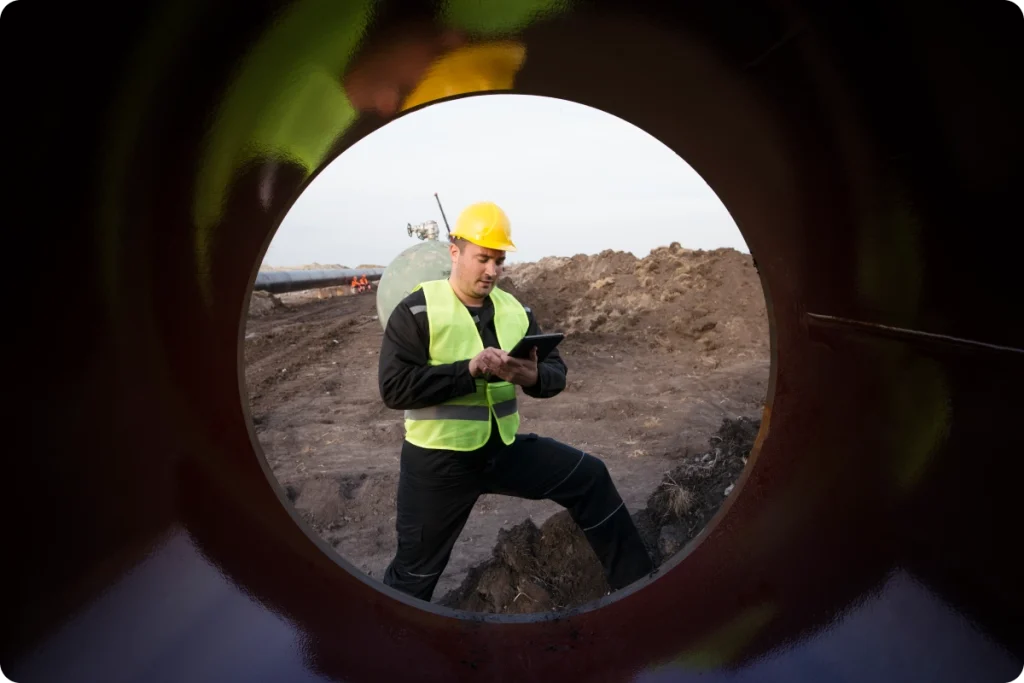
RBI Assesses risk to support the inspection planning. Risk is computed for the relevant pressurized equipment and the failure mode loss of containment, caused by either material deterioration or external influence (such as dropped objects). Risk of failure (RoF) is assessed quantitatively following a two-dimensional risk perspective, comprising the probability of failure (PoF) and the consequence of failure (CoF), and is typically expressed as the product of the two.(Ref API RP 580). Risk-Based Inspection (RBI) assessment services analyze the potential risks of each asset in your facility in their current operating conditions, and then allows users to choose from highly effective to least-effective inspection techniques based on the asset’s anticipated damage mechanism. Risk-Based Inspection (RBI) are conducted in terms of both the probability of failure and the consequence of failure, providing users with a unique view of the condition of each fixed asset in reference to each other.
Reliability, Availability & Maintainability (RAM)

Method of estimating the production availability of a system by assessing failure modes, frequencies and consequences, all the while paying attention to the effect on production. Reliability defines the failure frequency and determines the uptime patterns. Maintainability describes how soon the unit/system can be repaired, which determines the downtime patterns. Availability is the percentage of uptime over the time horizon, and is determined by reliability and maintainability. Reliability, Availability and Maintainability (RAM) study is a structured and quantitative approach implemented for asset optimization and work on the Monte-Carlo principle to significantly lower project costs. Maros is a cost-worthy and basic-level RAM Study Software for reliability engineering studies and reliability modelling to constitute real life scenarios, allowing us to evaluate and enhance production efficiency.
Project Health, Safety and Environment Reviews (PHSER)

PHSER is a high level HSE Audit designed to assist a Project team to follow corporate philosophies, applicable codes, standards, and regulatory requirements. PHSER involves a multi-disciplinary team of engineers, HSE and other Specialists who review documentation and activities at various stages, starting from Design , all Construction phases of a Project and then through Operations to Abandonment. The main purpose of the PHSER is to provide assurance to the Client that sensitive HSE areas have been identified and provide confidence that appropriate Project Engineering and Operational procedures, including those for Occupational Health & Safety, Fire Protection, Environmental Pollution Prevention, Energy Efficiency and Emergency Preparedness Procedures have been, or will be developed to control and manage the identified risks within a risk based Design.
Environmental Aspect - Impact Assessment (EIA) Studies

Environmental Impact Assessment (EIA) is the process of identifying, predicting, evaluating and mitigating the biophysical, social, and other relevant effects of development proposals prior to major decisions being taken and projects undertaken. EIAs are conducted in order to acquire an Environmental Authorization. There are two different types of assessments, Environmental Impact & Scoping (EIS) and Basic Assessment (BA), which are used to identify and evaluate the environmental aspects and implement mitigation measures for the Project.
Our Services Have Been Utilized by Organisations Across the Globe

USA

Kuwait

UAE

KSA

Iraq

Oman

Bahrain

Qatar

India
Frequently asked questions
HSE consultancy is a service that helps businesses to identify and manage their health, safety, and environmental risks. By implementing an HSE consultancy program, your business can ensure that it is fully compliant with relevant regulations, reduce the likelihood of accidents and incidents, and create a culture of safety and responsibility among your employees.
HSE consultancy services are relevant to all types of businesses, from small to large, in any industry. Whether you are a manufacturer, retailer, service provider, or any other type of business, HSE consultancy can help you to manage your risks and protect your employees and customers.
HSE consultancy services can include a range of services, such as Risk Assessments, System Development, HSE Audits, HSE Training, HSE Management System Development, Incident Investigation, Compliance Monitoring, Environmental Studies such as EIA, HAZOP, HAZID, SIL, etc.
When choosing an HSE consultancy provider, it is important to look for a provider with extensive experience in your industry, a strong track record of success, and a commitment to ongoing training and development. You should also look for a provider that can offer customized solutions that meet your specific needs.
HSE consultancy services can help you to understand and comply with relevant HSE regulations by providing expert guidance, conducting HSE audits and risk assessments, and developing HSE management systems that are compliant with relevant standards.