
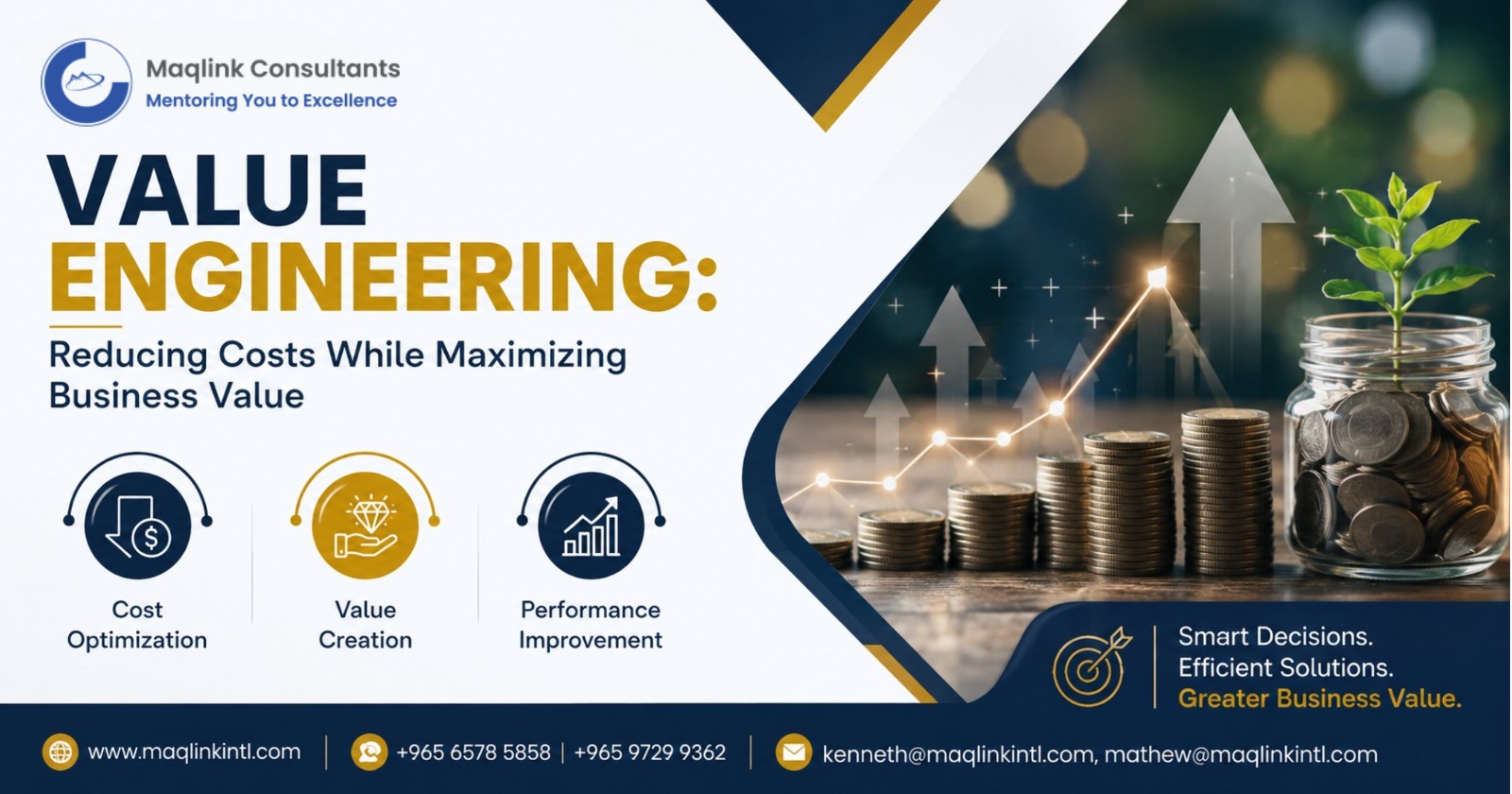
In a competitive business environment, organizations are constantly looking for ways to improve profitability without affecting quality. Rising operating costs, changing customer expectations, and increasing competition make it important for businesses to use their resources more effectively.
But cost reduction does not always mean simply spending less.
Cutting the wrong expense can reduce quality, affect performance, or create problems for customers. Value Engineering takes a more balanced approach. It focuses on understanding what a product, service, process, or project needs to achieve and finding better ways to deliver that value.
The objective is simple: reduce unnecessary costs while maintaining or improving quality, functionality, and performance.
What Is Value Engineering?
Value Engineering is a structured approach to examining the functions of a product, service, process, or project and identifying opportunities to improve value.
It asks a practical question:
Can we achieve the required result in a better, simpler, or more efficient way?
For example, a manufacturer may discover that a different material can provide the same required performance at a lower cost. A service organization may identify unnecessary approval steps that slow down customer service. A project team may find a more efficient design without affecting the final outcome.
The focus is not on making something cheaper at any cost. It is about making it more valuable and efficient.
Cost Optimization Without Compromising Quality
One of the biggest benefits of Value Engineering is its ability to support cost optimization while protecting important quality requirements.
Traditional cost-cutting can sometimes focus only on the immediate price. Value Engineering looks at the bigger picture.
A cheaper component may appear attractive, but if it requires frequent replacement or creates quality problems, the business could end up spending more over time.
Value Engineering considers factors such as:
- Cost
- Quality
- Functionality
- Performance
- Risk
- Customer requirements
- Lifecycle impact
This helps businesses make better-informed decisions rather than focusing only on short-term savings.
Creating More Value from Existing Resources
Every organization has limited resources. Materials, time, people, technology, equipment, and capital all need to be used wisely.
Value Engineering helps businesses identify where resources may be unnecessarily consumed.
Opportunities can exist in areas such as:
- Product design
- Procurement
- Production
- Maintenance
- Logistics
- Workflow
- Technology
- Resource utilization
Even a small improvement can have a significant impact when repeated across thousands of products, transactions, or operational activities.
Improving Business Performance
Value Engineering is not only about reducing expenses. It can also improve the way an organization operates.
Removing unnecessary steps can make processes faster. Simplifying a product can make manufacturing easier. Better resource planning can reduce waste. Reviewing supplier requirements can improve purchasing efficiency.
These improvements can contribute to:
Lower costs + Better efficiency + Reduced waste + Greater value = Stronger business performance
The approach also encourages different departments to work together. Finance, operations, procurement, engineering, quality, and management may each see an opportunity from a different perspective.
Combining these perspectives can lead to better solutions.
Making Value Engineering Part of Continuous Improvement
Value Engineering should not be treated as a one-time cost-saving exercise.
Markets change. Technology develops. Customer expectations evolve. A process that was efficient several years ago may no longer be the best option today.
Regularly reviewing how value is created and delivered allows organizations to identify new opportunities for improvement.
This creates a culture where employees ask:
Can we do this better?
Can we reduce waste without reducing value?
Can we deliver more with the resources we already have?
These questions can encourage innovation and continuous improvement across the organization.
Conclusion
Value Engineering provides businesses with a practical way to improve profitability while protecting quality and performance.
It is not simply about cutting costs. It is about understanding what creates value, identifying unnecessary expenditure, improving processes, and finding smarter ways to achieve the required results.
At Maqlink International Management Consultants, we help organizations explore opportunities in Value Engineering, Cost Optimization, Process Improvement, and Business Excellence to improve efficiency and strengthen overall performance.
In a competitive market, the goal is not simply to spend less.
The real goal is to create more value from every resource your business uses.