
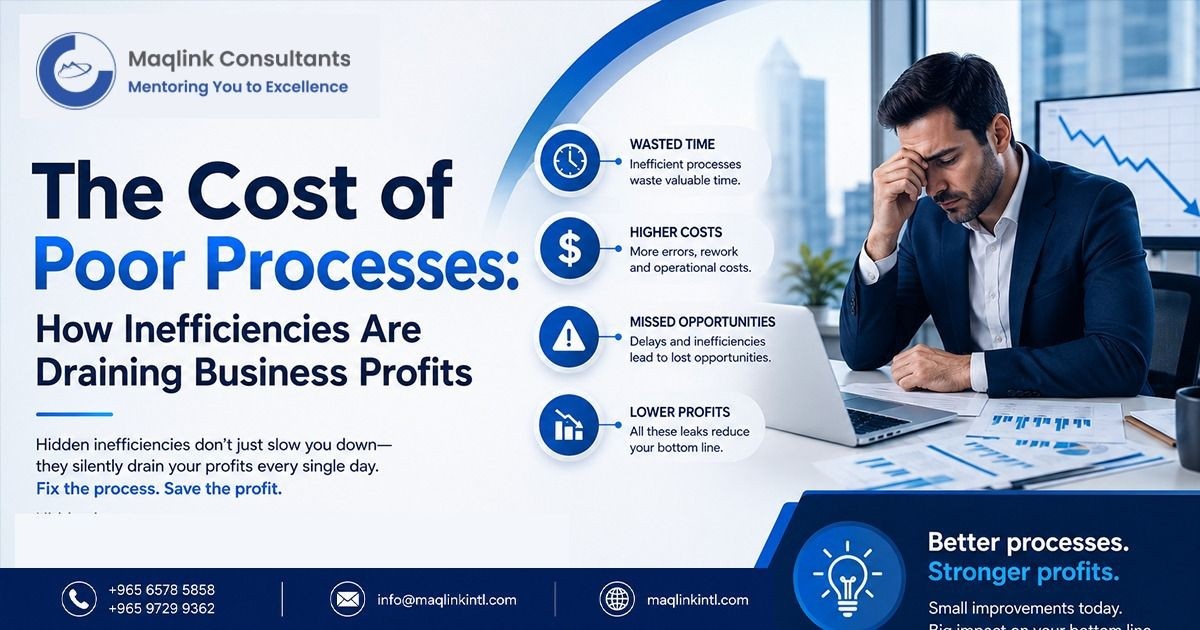
Every business owner wants to increase profits, improve productivity, and deliver better customer experiences. Yet many organizations focus heavily on sales growth while overlooking a critical factor that directly impacts profitability: inefficient business processes.
Poor processes often operate silently in the background. They create delays, increase costs, frustrate employees, and reduce customer satisfaction. While these issues may seem minor when viewed individually, their cumulative impact can significantly affect business performance over time.
Understanding how process inefficiencies drain profits is the first step toward creating a more productive and profitable organization.
The Hidden Costs of Inefficient Processes
Many business leaders can easily identify major expenses such as payroll, rent, or marketing costs. However, the financial impact of inefficient workflows is often harder to measure.
Consider common workplace scenarios:
- Employees spend hours searching for information.
- Tasks are duplicated across departments.
- Approval processes require multiple unnecessary steps.
- Manual data entry leads to errors and rework.
- Projects are delayed due to poor communication.
Each of these inefficiencies consumes valuable time and resources. When repeated daily across an organization, they create substantial hidden costs that reduce profitability.
Research consistently shows that organizations with streamlined operations are better positioned to control costs, improve productivity, and achieve sustainable growth. This is why process improvement has become a strategic priority for successful businesses.
How Poor Processes Impact Operational Efficiency
Operational efficiency refers to an organization's ability to deliver products or services using the least amount of resources while maintaining quality standards.
When processes are poorly designed, operational efficiency suffers in several ways.
Increased Labor Costs
Employees often spend a significant portion of their workday performing repetitive administrative tasks instead of focusing on high-value activities. Manual processes require more effort, increase workload, and often necessitate additional staffing.
Higher Error Rates
Complex or unclear processes create opportunities for mistakes. Errors lead to rework, customer complaints, compliance risks, and additional operational expenses. In many cases, fixing mistakes costs far more than preventing them in the first place.
Slower Response Times
Customers expect quick responses and seamless experiences. Inefficient workflows can slow down order processing, customer support, project delivery, and decision-making. Delays not only impact customer satisfaction but can also result in lost revenue opportunities.
Resource Waste
Poor coordination between teams often leads to duplicated work, unnecessary meetings, and underutilized resources. These inefficiencies reduce overall productivity and limit organizational growth.
The Connection Between Process Improvement and Business Performance
Strong business performance is rarely achieved through increased sales alone. Sustainable growth requires systems and processes that support efficiency, consistency, and scalability.
Process improvement focuses on identifying bottlenecks, eliminating waste, and optimizing workflows to achieve better outcomes.
Businesses that invest in process improvement often experience:
- Reduced operating costs
- Faster project completion
- Improved employee productivity
- Higher customer satisfaction
- Better compliance and risk management
- Increased profitability
When processes become more efficient, organizations can accomplish more with the same resources, creating a direct positive impact on the bottom line.
Warning Signs Your Business Has Process Problems
Many organizations operate with inefficient processes for years without realizing the extent of the problem. Recognizing early warning signs can help prevent larger issues from developing.
Common indicators include:
- Frequent project delays
- Repeated customer complaints
- Excessive overtime costs
- High employee frustration or turnover
- Inconsistent service delivery
- Difficulty scaling operations
- Lack of visibility into workflow performance
If your business is experiencing several of these challenges, it may be time to evaluate existing workflows and identify opportunities for improvement.
Practical Steps to Improve Operational Efficiency
Improving processes does not necessarily require a complete organizational overhaul. Small, targeted changes can produce significant results.
Map Existing Workflows
Begin by documenting current processes from start to finish. Understanding how work actually flows through the organization helps identify inefficiencies and bottlenecks.
Eliminate Unnecessary Steps
Review workflows carefully and remove activities that do not add value. Simplifying processes often reduces delays and improves productivity.
Automate Repetitive Tasks
Technology can significantly improve operational efficiency by automating routine activities such as data entry, reporting, scheduling, and approvals.
Standardize Procedures
Clear and consistent procedures help reduce errors, improve training, and ensure quality across teams.
Monitor Performance Metrics
Establish key performance indicators (KPIs) to measure process effectiveness. Regular monitoring enables continuous improvement and helps identify emerging issues before they become costly problems.
Building a Culture of Continuous Improvement
Successful process improvement is not a one-time project. It requires an ongoing commitment to evaluating and refining how work gets done.
Organizations that encourage employee feedback, embrace innovation, and regularly review workflows are more likely to maintain high levels of operational efficiency. Employees who work closely with processes often have valuable insights into potential improvements and should be actively involved in optimization efforts.
A culture of continuous improvement helps businesses remain agile, competitive, and prepared for future growth.
Conclusion
The impact of poor processes extends far beyond simple inconvenience. Inefficient workflows increase costs, reduce productivity, create customer dissatisfaction, and ultimately undermine business performance.
While many organizations focus on revenue growth, the greatest profit opportunities may already exist within their operations. By prioritizing process improvement and enhancing operational efficiency, businesses can eliminate waste, improve productivity, and strengthen long-term profitability.
In today's competitive business environment, companies that continuously optimize their processes gain a significant advantage. The question is not whether your business can afford to improve its processes—it is whether it can afford not to.