
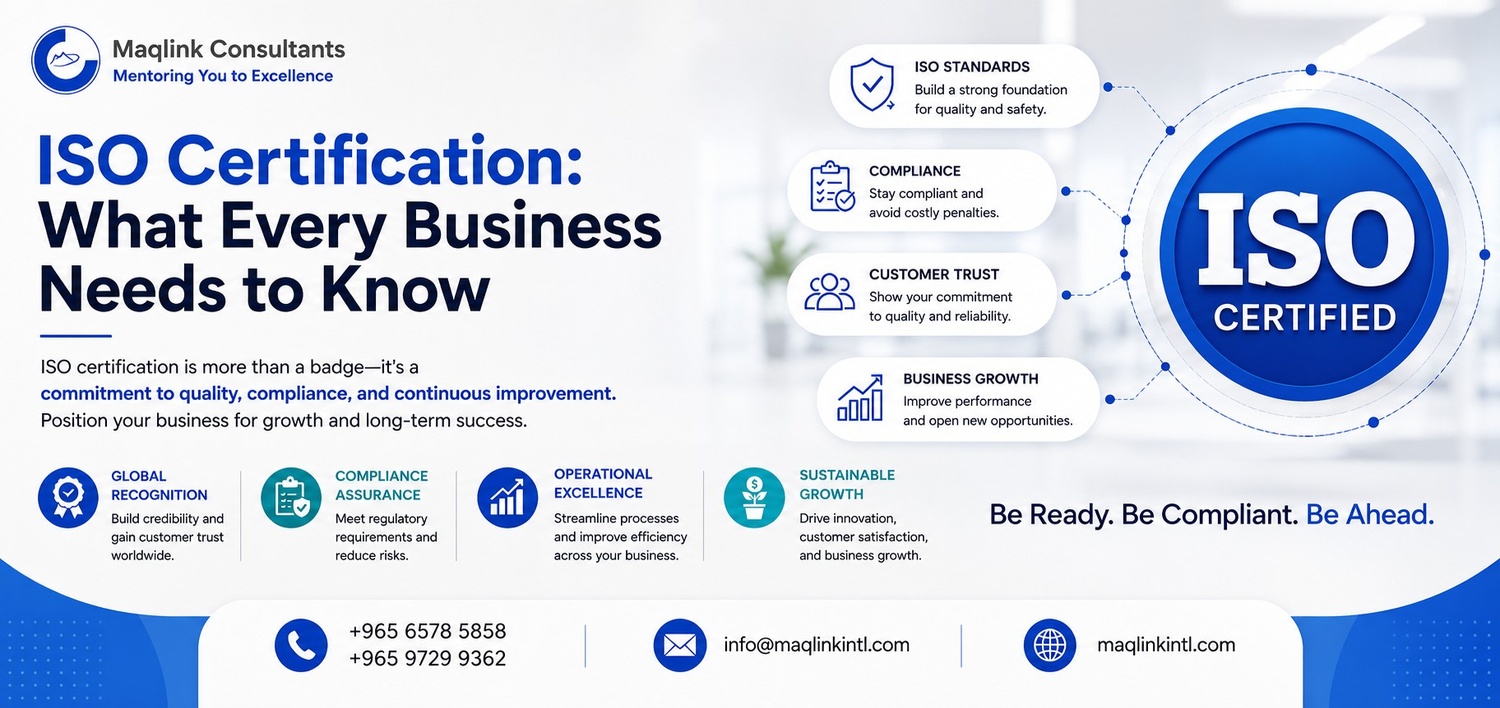
In today's competitive business environment, organizations are under constant pressure to improve quality, meet customer expectations, comply with regulations, and operate more efficiently. As businesses continue to navigate evolving market demands and increasing stakeholder expectations, internationally recognized standards have become more important than ever.
This is why ISO certification continues to play a significant role in helping organizations build credibility, improve performance, and achieve sustainable growth.
As we move through 2026, many business leaders are asking an important question: Is ISO certification still relevant?
The answer is a clear yes.
In fact, ISO certification has become more valuable as organizations face increasing challenges related to compliance, risk management, customer trust, cybersecurity, sustainability, and operational excellence.
What Is ISO Certification?
ISO certification is a formal recognition that an organization has implemented and maintains a management system that meets the requirements of an internationally recognized ISO standard.
The International Organization for Standardization (ISO) develops standards that provide frameworks for improving business performance, quality, safety, information security, environmental management, energy management, business continuity, and many other areas.
Some of the most widely adopted standards include:
- ISO 9001 – Quality Management Systems
- ISO 14001 – Environmental Management Systems
- ISO 45001 – Occupational Health and Safety Management Systems
- ISO 27001 – Information Security Management Systems
- ISO 22301 – Business Continuity Management Systems
- ISO 50001 – Energy Management Systems
- ISO 27701 – Privacy Information Management Systems
While each standard serves a different purpose, they all share a common goal: helping organizations improve performance through structured management systems.
Why ISO Certification Matters in 2026
Businesses today operate in a much different environment than they did a decade ago.
Customers have higher expectations. Regulatory requirements are becoming more complex. Digital transformation continues to accelerate. Cybersecurity threats are increasing. Sustainability has become a strategic priority.
In this environment, organizations need systems that support consistency, accountability, and continual improvement.
ISO certification provides exactly that.
Rather than relying on informal practices or individual efforts, organizations implement structured processes that help them operate more effectively and consistently.
This not only improves internal performance but also strengthens confidence among customers, partners, regulators, and stakeholders.
ISO Certification Is More Than a Certificate
One of the biggest misconceptions about ISO certification is that it is simply a certificate displayed on a wall.
Successful organizations understand that ISO certification is not about obtaining a document. It is about improving how the business operates.
A properly implemented management system helps organizations:
- Define clear processes
- Improve accountability
- Reduce operational risks
- Enhance customer satisfaction
- Improve decision-making
- Increase efficiency
- Support continual improvement
The certification itself is important, but the real value comes from the systems and practices developed during implementation.
Building Customer Confidence
Trust has become a critical business asset.
Customers want assurance that the organizations they work with can consistently deliver quality products and services.
ISO certification demonstrates a commitment to internationally recognized best practices.
For many customers, particularly in business-to-business environments, certification serves as evidence that an organization has established reliable systems and processes.
In some industries, certification has become a requirement for participating in tenders, securing contracts, or entering new markets.
Organizations that invest in certification often find that it strengthens their credibility and competitive position.
Supporting Compliance and Risk Management
Compliance requirements continue to evolve across industries.
Organizations face increasing expectations related to quality, safety, environmental performance, information security, privacy, and operational resilience.
Managing these requirements can become challenging without a structured approach.
ISO standards provide organizations with frameworks for identifying risks, establishing controls, monitoring performance, and maintaining compliance.
Rather than reacting to problems after they occur, organizations can take a proactive approach to risk management.
This helps reduce disruptions, improve resilience, and support long-term business stability.
Improving Operational Efficiency
Operational efficiency remains a priority for businesses seeking sustainable growth.
Many organizations struggle with process inconsistencies, duplicated work, communication gaps, and unnecessary operational costs.
ISO implementation helps address these challenges by introducing structured processes and clearly defined responsibilities.
Organizations often experience improvements such as:
- Better workflow management
- Reduced errors
- Improved productivity
- Stronger process consistency
- Better resource utilization
- Faster problem resolution
These improvements contribute directly to overall business performance.
The Growing Importance of Specialized Standards
While standards such as ISO 9001 remain widely adopted, businesses are increasingly exploring specialized standards that address emerging challenges.
ISO 27001 – Information Security
As cyber threats continue to increase, protecting sensitive information has become a business priority.
ISO 27001 helps organizations establish structured information security controls and manage cybersecurity risks effectively.
ISO 22301 – Business Continuity
Unexpected disruptions can have serious consequences for organizations.
ISO 22301 helps businesses prepare for crises, maintain critical operations, and recover more effectively when disruptions occur.
ISO 50001 – Energy Management
Organizations are paying closer attention to energy performance and operational efficiency.
ISO 50001 provides a framework for improving energy management and reducing unnecessary resource consumption.
ISO 27701 – Privacy Management
Data privacy expectations continue to grow.
ISO 27701 helps organizations strengthen privacy management practices and protect personal information more effectively.
These standards demonstrate how ISO continues to evolve alongside modern business challenges.
Common Challenges During ISO Implementation
Although the benefits of ISO certification are significant, implementation is not always straightforward.
Many organizations face challenges such as:
- Limited internal expertise
- Resistance to change
- Inconsistent documentation
- Lack of employee awareness
- Difficulty interpreting standard requirements
These challenges can delay implementation and reduce the effectiveness of the management system.
This is why many organizations choose to work with experienced consultants who can provide guidance, training, and implementation support throughout the certification journey.
Making ISO Certification Successful
Successful ISO implementation requires more than documentation.
Organizations achieve the best results when they:
- Secure leadership commitment
- Involve employees throughout the process
- Focus on practical implementation
- Conduct regular internal audits
- Monitor performance continuously
- Embrace continual improvement
When ISO becomes part of organizational culture rather than a compliance exercise, businesses gain far greater value from certification.
Looking Ahead
As business environments continue to evolve, the importance of structured management systems will only increase.
Organizations must be prepared to address changing regulations, customer expectations, cybersecurity threats, operational risks, and sustainability challenges.
ISO standards provide proven frameworks that help organizations navigate these complexities with greater confidence.
Businesses that invest in effective management systems today will be better positioned to adapt, compete, and grow in the future.
Conclusion
ISO certification remains one of the most effective tools available for organizations seeking to improve quality, strengthen compliance, manage risks, and support business growth.
More importantly, ISO certification is not simply about meeting requirements. It is about building stronger systems, improving performance, and creating a foundation for long-term success.
At Maqlink International Management Consultants, we support organizations through awareness training, implementation consultancy, internal auditor training, gap assessments, and certification support across a wide range of ISO standards. Our goal is to help businesses implement practical management systems that deliver measurable value and sustainable results.
In 2026 and beyond, organizations that invest in strong systems, continual improvement, and internationally recognized best practices will be better equipped to succeed in an increasingly competitive world.