
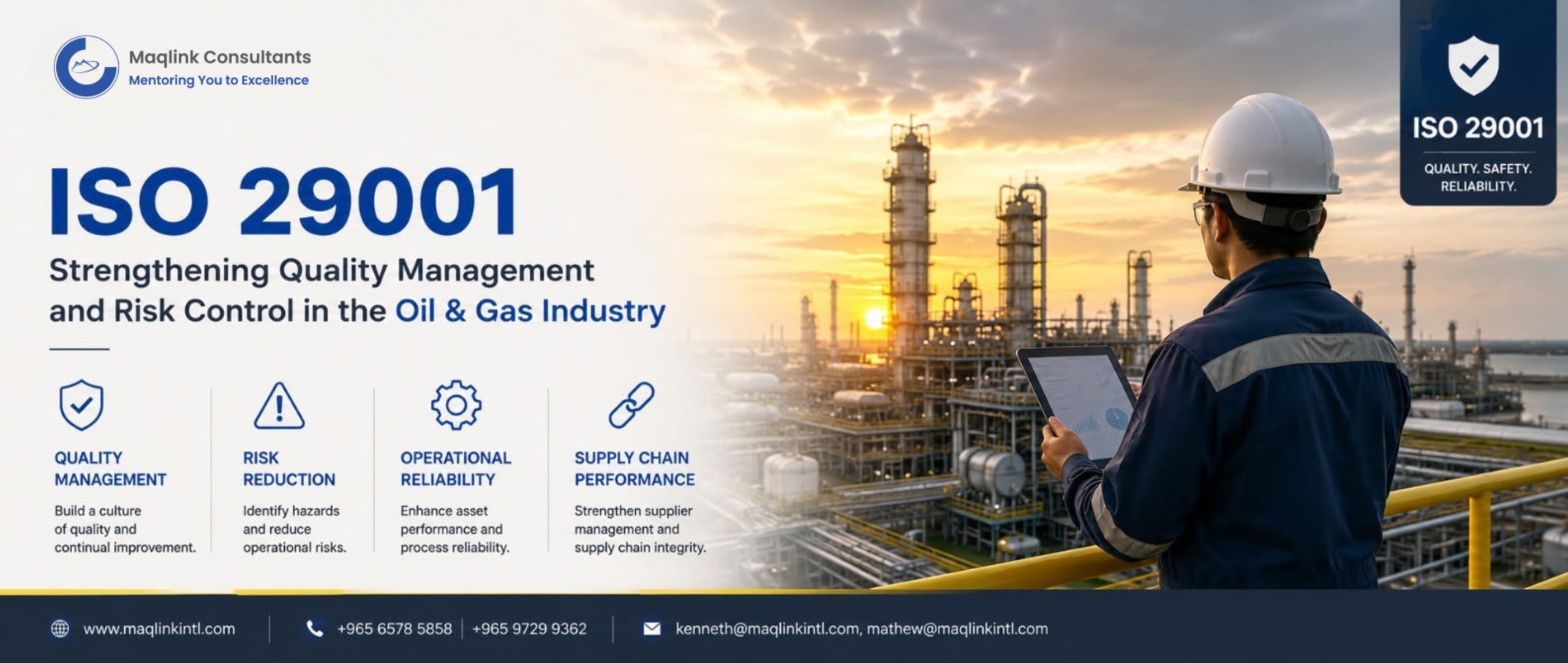
The oil and gas industry operates in one of the most demanding business environments in the world. Every stage of the value chain—from exploration and drilling to refining, transportation, and distribution—requires precision, consistency, and strict quality control. Even a small error can lead to operational disruptions, environmental incidents, financial losses, or safety risks.
As the industry continues to evolve, organizations are under increasing pressure to deliver high-quality products while maintaining operational reliability, managing complex supply chains, and meeting strict regulatory requirements.
This is where ISO 29001 plays a vital role.
Developed specifically for the petroleum, petrochemical, and natural gas industries, ISO 29001 provides a structured quality management framework that helps organizations improve operational performance, reduce risks, and strengthen confidence across the supply chain.
Rather than being another compliance requirement, ISO 29001 helps businesses build systems that support long-term operational excellence.
Understanding ISO 29001
ISO 29001 is an internationally recognized Quality Management System (QMS) standard designed specifically for organizations operating within the oil, gas, and petrochemical sectors.
While it is based on the principles of ISO 9001, ISO 29001 includes additional industry-specific requirements that address the unique risks and operational challenges faced by energy companies.
The standard focuses on:
- Quality management
- Risk prevention
- Product conformity
- Supplier performance
- Operational consistency
- Continuous improvement
Its purpose is to reduce the likelihood of defects, improve process reliability, and ensure that products and services consistently meet customer and regulatory requirements.
Why Quality Matters in Oil and Gas
Quality is far more than meeting technical specifications.
In the oil and gas industry, quality directly influences safety, operational efficiency, environmental protection, and business performance.
Poor quality can result in:
- Equipment failures
- Production delays
- Costly shutdowns
- Supply chain disruptions
- Safety incidents
- Environmental damage
- Loss of customer confidence
Because many operations involve high pressures, hazardous materials, and complex engineering systems, even minor quality issues can create significant consequences.
Organizations that prioritize quality management are better equipped to prevent problems before they occur.
Managing Risk Through Better Systems
Risk is part of every oil and gas operation.
Whether it involves drilling equipment, pipelines, processing plants, contractors, or suppliers, every activity introduces potential risks that must be effectively managed.
ISO 29001 encourages organizations to adopt a proactive approach to risk management.
Rather than responding after problems arise, businesses are encouraged to identify potential risks early, evaluate their impact, and implement effective controls.
This preventive approach helps organizations:
- Reduce operational failures
- Improve product quality
- Strengthen process consistency
- Minimize costly rework
- Enhance decision-making
Managing risk systematically improves confidence across the entire organization.
Strengthening Supply Chain Performance
The oil and gas industry relies heavily on complex global supply chains.
Materials, equipment, components, and specialized services often come from multiple suppliers operating in different countries.
If just one supplier fails to meet quality requirements, the effects can impact entire projects.
ISO 29001 helps organizations establish consistent supplier evaluation and quality control processes.
This includes:
- Defining supplier requirements
- Monitoring supplier performance
- Verifying product quality
- Managing non-conforming materials
- Encouraging supplier improvement
A stronger supply chain reduces uncertainty and improves overall operational reliability.
Reliable suppliers contribute directly to reliable operations.
Improving Operational Reliability
Operational reliability is essential for organizations working in high-risk environments.
Unexpected equipment failures or process interruptions can result in expensive downtime and reduced productivity.
ISO 29001 promotes standardized procedures that improve consistency across operations.
By documenting processes, monitoring performance, and implementing corrective actions, businesses gain greater control over daily activities.
Improved reliability leads to:
- Reduced operational disruptions
- Better asset performance
- Increased production efficiency
- Improved maintenance planning
- More predictable operational outcomes
Organizations that consistently deliver reliable performance are better positioned to meet customer expectations and achieve sustainable growth.
A Culture of Continuous Improvement
Successful organizations never stop improving.
One of the strengths of ISO 29001 is its emphasis on continual improvement.
Rather than treating quality as a one-time initiative, the standard encourages organizations to regularly evaluate performance and identify opportunities for enhancement.
Continuous improvement may include:
- Reviewing operational data
- Investigating non-conformities
- Learning from incidents
- Improving employee competence
- Enhancing supplier relationships
- Optimizing operational processes
Small improvements implemented consistently often produce significant long-term results.
Continuous improvement helps organizations remain competitive in an industry where expectations continue to rise.
Supporting Regulatory Compliance
Oil and gas companies operate within highly regulated environments.
Compliance with industry regulations, customer requirements, and contractual obligations is essential.
ISO 29001 helps organizations establish documented processes that support compliance while reducing the likelihood of quality-related issues.
Instead of viewing compliance as a separate activity, businesses integrate quality management into their everyday operations.
This creates greater consistency while reducing the administrative burden associated with audits and inspections.
Compliance becomes part of the organizational culture rather than simply an annual exercise.
Building Customer Confidence
Customers expect suppliers to deliver products and services that meet strict quality requirements.
Consistency builds trust.
Organizations implementing ISO 29001 demonstrate their commitment to quality, reliability, and continual improvement.
This strengthens confidence among:
- Customers
- Business partners
- Contractors
- Investors
- Regulatory authorities
In a competitive industry, strong quality management often becomes a key differentiator when securing contracts and long-term business relationships.
Preparing for the Future
The oil and gas industry continues to evolve through digital transformation, automation, sustainability initiatives, and increasing customer expectations.
Organizations need management systems that can adapt to these changes while maintaining operational excellence.
ISO 29001 provides a strong foundation for future growth by encouraging businesses to improve quality, reduce risks, strengthen supply chain performance, and enhance operational resilience.
Businesses that invest in structured quality management today are better prepared to respond to tomorrow's challenges.
Conclusion
Quality management is not simply about meeting specifications—it is about protecting people, improving operational reliability, reducing risks, and creating long-term business value.
ISO 29001 provides oil, gas, and petrochemical organizations with a practical framework for strengthening quality management systems, improving supply chain performance, and supporting continual improvement across every stage of operations.
By implementing ISO 29001, businesses can reduce operational risks, enhance product quality, improve customer confidence, and build more resilient operations in an increasingly demanding industry.
At Maqlink International Management Consultants, we help organizations in the oil, gas, and petrochemical sectors implement ISO 29001 through expert consulting, gap assessments, awareness training, internal auditor training, implementation support, and certification guidance. Our goal is to help businesses develop practical quality management systems that improve performance, strengthen compliance, and support sustainable business growth.
In an industry where quality and reliability are critical, ISO 29001 is more than a standard—it is a strategic investment in operational excellence, risk reduction, and long-term success.