
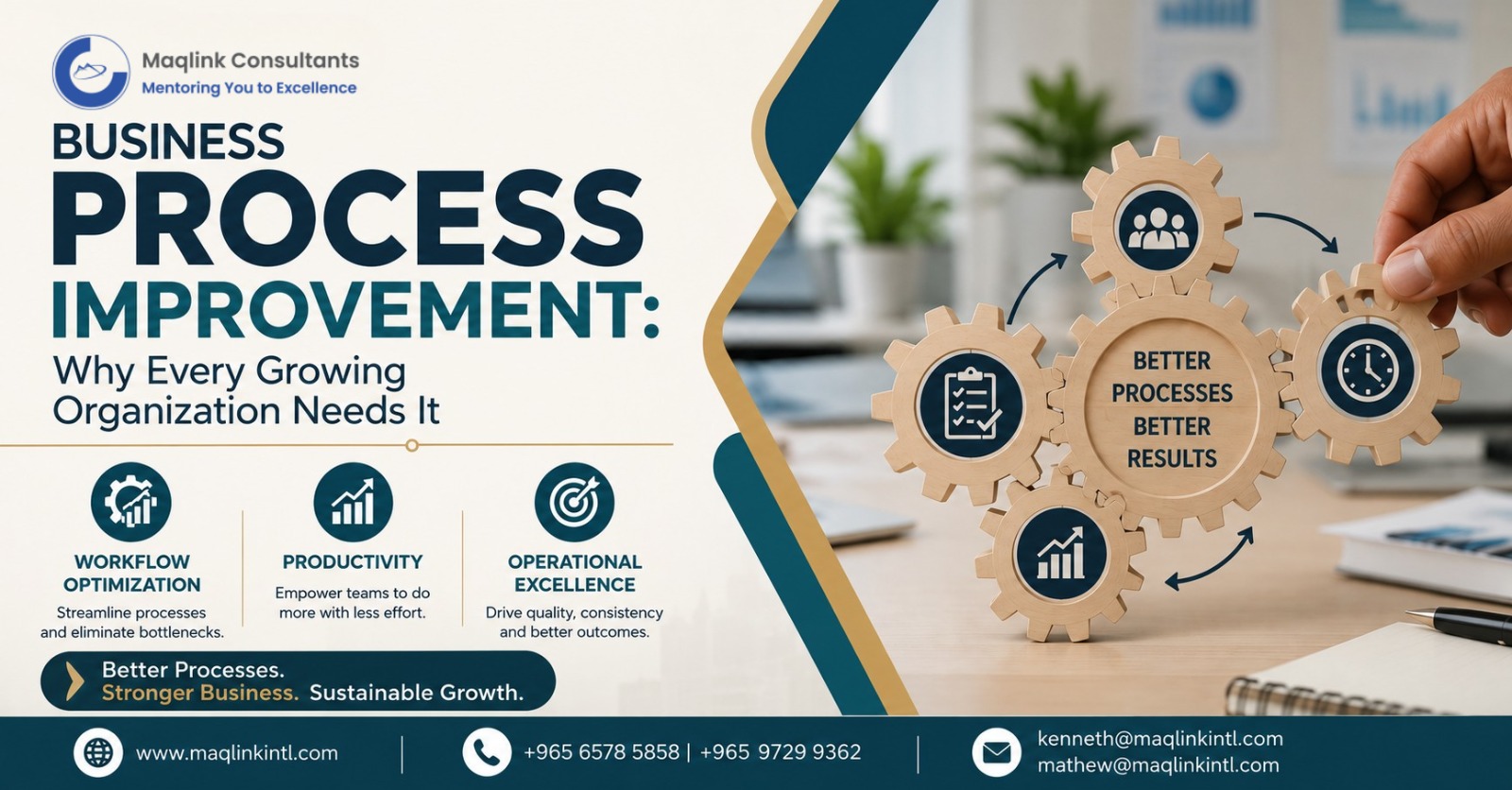
Growth is the goal of every business. Whether an organization is expanding its customer base, entering new markets, or increasing production capacity, growth is a sign of progress. However, growth also brings new challenges. As businesses become larger and more complex, inefficient processes that once seemed manageable can quickly become obstacles to success.
Many organizations focus heavily on increasing sales and acquiring new customers, but sustainable growth depends on something equally important—how efficiently the business operates behind the scenes.
This is where Business Process Improvement (BPI) becomes essential.
Business Process Improvement is not just about making workflows faster. It is about creating smarter, more efficient ways of working that improve productivity, reduce waste, enhance customer satisfaction, and support long-term business success.
What Is Business Process Improvement?
Business Process Improvement is the structured approach of analyzing, evaluating, and improving existing business processes to make them more efficient, effective, and customer-focused.
Every organization relies on processes to deliver products and services. These processes include everything from purchasing materials and managing inventory to processing customer orders, responding to enquiries, and delivering after-sales support.
Over time, many of these processes become outdated or unnecessarily complicated. Extra approvals, duplicate tasks, poor communication, and manual activities often develop as businesses grow.
Business Process Improvement helps organizations identify these inefficiencies and replace them with streamlined workflows that deliver better results.
The objective is simple: achieve more with the resources already available.
Why Growing Organizations Need Better Processes
When a business is small, employees can often solve problems informally. Communication is simple, teams are smaller, and decision-making is faster.
As the organization grows, however, operations become more complex.
New employees join the company. Customer expectations increase. Product lines expand. Multiple departments begin working together. Without structured processes, growth can create confusion rather than efficiency.
Common challenges include:
- Delayed approvals
- Poor communication between departments
- Duplicate work
- Missed deadlines
- Inconsistent customer experiences
- Higher operational costs
- Increased employee workload
These issues slow down productivity and make it harder for businesses to scale successfully.
Business Process Improvement creates consistency that allows organizations to grow without losing control of their operations.
The Link Between Process Improvement and Productivity
Productivity is not about asking employees to work harder. It is about helping them work smarter.
When processes are inefficient, employees spend valuable time correcting mistakes, searching for information, waiting for approvals, or repeating tasks that could have been completed more efficiently.
Improved processes eliminate unnecessary activities and allow teams to focus on work that creates value.
Organizations often experience productivity improvements through:
- Simplified workflows
- Clear responsibilities
- Reduced manual work
- Better collaboration
- Faster decision-making
- Improved resource utilization
Higher productivity benefits both employees and customers by improving service delivery and operational performance.
Operational Excellence Starts with Better Processes
Operational excellence is achieved when an organization consistently delivers high-quality products and services while using resources efficiently.
It is not achieved through isolated improvements but through well-designed systems that support continuous performance.
Business Process Improvement provides the foundation for operational excellence by helping organizations:
- Standardize operations
- Reduce process variation
- Improve quality
- Increase consistency
- Strengthen accountability
- Support continuous improvement
When processes are documented and regularly reviewed, organizations become more agile and better prepared to respond to changing business conditions.
Better Processes Create Better Customer Experiences
Customers may never see an organization's internal workflows, but they experience the results every day.
Late deliveries, inconsistent quality, delayed responses, and communication failures often originate from inefficient internal processes.
On the other hand, streamlined operations enable organizations to deliver:
- Faster response times
- Consistent service quality
- Accurate order processing
- Reliable delivery schedules
- Improved customer communication
Every improvement made internally contributes to a better customer experience externally.
Satisfied customers are more likely to become loyal customers, making process improvement an important driver of business growth.
Reducing Waste and Improving Efficiency
Every business has hidden inefficiencies that consume valuable time, money, and resources.
These may include:
- Duplicate data entry
- Unnecessary approvals
- Excess inventory
- Rework due to quality issues
- Manual paperwork
- Poor resource allocation
- Inefficient communication
Business Process Improvement helps organizations identify these areas and eliminate activities that do not add value.
Reducing waste not only lowers operational costs but also allows employees to focus on activities that contribute directly to organizational success.
Technology Supports Process Improvement
Digital transformation has created new opportunities for organizations to improve efficiency through automation and data-driven decision-making.
However, technology alone cannot solve inefficient processes.
Automating a poor process simply allows mistakes to happen faster.
Before investing in technology, organizations should first understand and optimize their workflows.
Once processes are improved, technology becomes a powerful tool for increasing efficiency, improving accuracy, and enhancing collaboration.
Successful digital transformation begins with strong business processes.
Building a Culture of Continuous Improvement
Business Process Improvement should not be treated as a one-time project.
Markets evolve, customer expectations change, and organizations continue to grow. Processes that work well today may require adjustments tomorrow.
Successful organizations encourage continuous improvement by regularly reviewing performance, gathering employee feedback, and identifying opportunities for enhancement.
Employees often have valuable insights into operational challenges because they work with processes every day.
Encouraging employee participation creates greater engagement while helping organizations identify practical improvement opportunities.
Continuous improvement becomes part of the organizational culture rather than an occasional initiative.
Leadership's Role in Process Improvement
Business Process Improvement requires strong leadership commitment.
Leaders set priorities, allocate resources, and create an environment where improvement is encouraged.
Successful leaders understand that improving processes is an investment rather than an expense.
They focus on long-term performance instead of short-term fixes.
When leadership actively supports improvement initiatives, employees become more willing to embrace change and contribute to organizational success.
Leadership commitment is often the difference between temporary improvements and sustainable transformation.
Preparing for Sustainable Growth
Growth without efficient processes often creates operational challenges.
Organizations that expand without improving workflows may experience increasing costs, declining customer satisfaction, and reduced employee productivity.
Business Process Improvement prepares organizations for sustainable growth by creating systems that are scalable, measurable, and adaptable.
Businesses with strong processes are better equipped to:
- Manage increased demand
- Improve operational resilience
- Respond to market changes
- Maintain consistent quality
- Support long-term strategic goals
Rather than simply growing larger, they become stronger and more efficient.
Conclusion
Business Process Improvement is no longer optional for organizations seeking sustainable growth. It provides the structure needed to improve workflow efficiency, increase productivity, strengthen operational excellence, and deliver better customer experiences.
By continuously reviewing and improving business processes, organizations can reduce waste, optimize resources, and build a stronger foundation for future success.
At Maqlink International Management Consultants, we help organizations achieve operational excellence through Business Process Improvement, Business Excellence consulting, Value Engineering, Lean Six Sigma, and performance improvement initiatives. Our experienced consultants work closely with businesses to identify opportunities, streamline operations, and create practical solutions that drive measurable results.
In today's competitive business environment, organizations that improve their processes are better positioned to improve performance, delight customers, and achieve sustainable long-term growth. Efficient processes don't just support growth—they make it possible.