
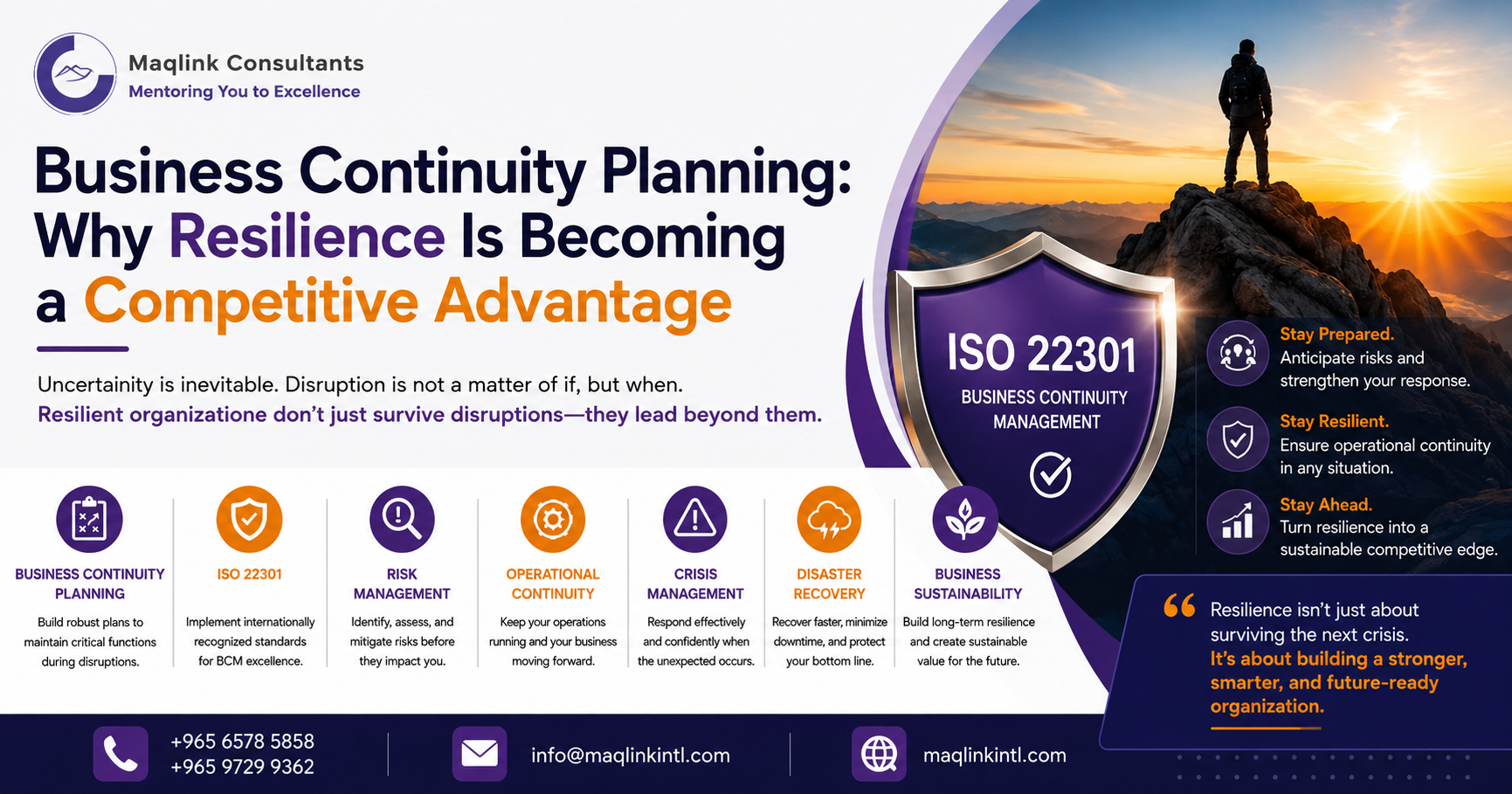
Business Continuity Planning: Why Resilience Is Becoming a Competitive Advantage
In today's business environment, uncertainty has become a constant. Organizations face challenges from every direction—cybersecurity threats, supply chain disruptions, economic fluctuations, regulatory changes, natural disasters, and evolving customer expectations. While businesses cannot predict every disruption, they can prepare for them.
This is why Business Continuity Planning (BCP) is no longer viewed as merely a risk management exercise. It has become a strategic business capability that helps organizations remain stable, responsive, and competitive during times of uncertainty.
The organizations that recover quickly from disruptions often share one common characteristic: resilience.
Increasingly, business resilience is becoming a genuine competitive advantage.
Understanding Business Continuity Planning
Business Continuity Planning is the process of preparing an organization to continue operating during and after a disruption.
The goal is not simply to react to emergencies. Instead, it is to ensure that critical business functions can continue with minimal interruption, protecting customers, employees, stakeholders, and business performance.
A well-developed Business Continuity Plan identifies potential risks, evaluates their impact, and establishes practical procedures for responding and recovering effectively.
Business continuity planning covers several areas, including:
- Critical business processes
- People and workforce management
- Technology and information systems
- Supply chain dependencies
- Facilities and infrastructure
- Customer communication
- Crisis management procedures
The objective is simple: keep the business functioning when unexpected events occur.
Why Business Resilience Matters More Than Ever
A decade ago, many organizations viewed business continuity as a compliance requirement or an emergency preparedness exercise.
Today, the conversation has changed.
Organizations now operate in a highly connected world where disruptions can spread quickly across industries and markets. A cyberattack affecting a supplier can impact hundreds of businesses. A transportation issue can interrupt entire supply chains. A regulatory change can force operational adjustments almost overnight.
As a result, resilience has become a key indicator of organizational strength.
Business resilience refers to an organization's ability to adapt, respond, recover, and continue delivering value during challenging circumstances.
Resilient organizations are not immune to disruption. Instead, they are prepared to manage disruption effectively.
The Hidden Cost of Disruption
Many businesses underestimate the true cost of operational interruptions.
The financial impact extends far beyond immediate losses.
Disruptions can lead to:
- Lost revenue
- Delayed projects
- Customer dissatisfaction
- Damaged reputation
- Regulatory consequences
- Increased operational costs
- Employee frustration
- Loss of market opportunities
In some cases, the reputational damage caused by a poorly managed crisis can take years to recover from.
Customers today expect reliability. They want confidence that the organizations they work with can maintain service levels even during difficult situations.
Organizations that demonstrate resilience often strengthen customer trust, while those that struggle may lose business to competitors.
Resilience as a Competitive Advantage
Traditionally, businesses competed through pricing, product quality, innovation, or customer service.
While these factors remain important, resilience is emerging as another key differentiator.
Why?
Because stakeholders increasingly value stability and reliability.
Customers prefer suppliers who can continue delivering during disruptions. Investors prefer organizations with strong risk management practices. Employees prefer workplaces that can navigate uncertainty with confidence.
When a disruption occurs, resilient businesses often gain advantages over competitors by:
- Maintaining customer service levels
- Preserving operational continuity
- Protecting revenue streams
- Responding faster to market changes
- Recovering more quickly from setbacks
In many cases, resilience transforms potential crises into opportunities for growth and stronger market positioning.
Common Mistakes Organizations Make
Despite the growing importance of business continuity planning, many organizations still make critical mistakes.
One common issue is assuming that disruptions are unlikely.
Many businesses believe major incidents only happen to larger organizations or businesses in high-risk industries. In reality, disruptions can affect any organization regardless of size or sector.
Another mistake is treating business continuity as a one-time project.
A plan created several years ago may no longer reflect current business operations, technologies, suppliers, or risks.
Business continuity planning must evolve alongside the organization.
Some businesses also focus exclusively on technology recovery while neglecting people, communication, and operational processes.
Effective resilience requires a comprehensive approach.
The Role of Risk Management
Business continuity planning and risk management work together.
Risk management helps organizations identify and assess potential threats before they occur.
These risks may include:
- Cybersecurity incidents
- Supply chain disruptions
- Equipment failures
- Workforce shortages
- Regulatory changes
- Natural disasters
- Financial instability
Once risks are identified, organizations can develop strategies to reduce their impact and improve preparedness.
Risk management is not about eliminating every threat. It is about understanding vulnerabilities and creating practical plans to address them.
Building Operational Stability
Operational stability is a critical outcome of effective business continuity planning.
Organizations with strong continuity frameworks are better positioned to maintain essential functions even when unexpected challenges arise.
Operational stability requires:
- Clearly documented processes
- Defined responsibilities
- Effective communication channels
- Backup systems and resources
- Employee training and awareness
- Regular testing and review
These elements help organizations respond consistently and efficiently during disruptions.
Without operational stability, even minor incidents can escalate into major operational challenges.
How ISO 22301 Supports Business Continuity
ISO 22301 is the internationally recognized standard for Business Continuity Management Systems (BCMS).
The standard provides a structured framework that helps organizations prepare for, respond to, and recover from disruptions.
Rather than focusing solely on crisis response, ISO 22301 promotes a proactive approach to resilience and continual improvement.
Organizations implementing ISO 22301 typically gain:
- Improved preparedness
- Enhanced risk management
- Greater operational continuity
- Faster recovery capabilities
- Increased stakeholder confidence
- Better organizational resilience
The standard helps embed business continuity into everyday operations rather than treating it as a separate activity.
This creates a culture of preparedness throughout the organization.
Business Sustainability and Long-Term Success
Business sustainability is often associated with environmental initiatives, but sustainability also includes an organization's ability to survive and thrive over time.
Organizations that cannot withstand disruptions face significant challenges in achieving long-term growth.
Business continuity planning contributes directly to sustainability by helping organizations maintain stability, protect critical operations, and adapt to changing circumstances.
Sustainable businesses understand that resilience is not built during a crisis.
It is built long before a crisis occurs.
Investing in preparedness today creates stronger foundations for future growth.
Looking Ahead
The future will continue to present new challenges.
Technology will evolve. Markets will shift. Customer expectations will change. New risks will emerge.
Organizations cannot predict every disruption, but they can develop the capability to respond effectively.
The businesses that succeed in the coming years will not necessarily be the largest or the most resource-rich. They will be the organizations that can adapt quickly, maintain continuity, and recover with confidence.
Resilience is no longer simply about survival.
It is becoming a defining characteristic of successful organizations.
Conclusion
Business Continuity Planning is no longer just a compliance requirement or emergency preparedness exercise. It is a strategic investment in organizational resilience, operational stability, and long-term sustainability.
Organizations that prioritize resilience are better equipped to manage uncertainty, protect stakeholder confidence, and maintain business performance when disruptions occur.
At Maqlink International Management Consultants, we help organizations strengthen resilience through Business Continuity Planning, ISO 22301 implementation, awareness training, internal auditor training, and certification support. Our goal is to help businesses build practical continuity frameworks that protect operations and support sustainable growth.
In an increasingly unpredictable world, resilience is more than a safeguard—it is a competitive advantage. Organizations that prepare today will be better positioned to succeed tomorrow.